Pokealong Geology — Part A
Early Permian Earth
The Early Permian Period was shaped by major changes in Earth’s geography, climate, plants, and animals. During this time, the supercontinent Pangaea brought the world’s landmasses together, southern regions still carried the effects of a lingering ice age, and early sail-backed synapsids such as Dimetrodon became dominant as the planet gradually shifted toward a drier climate.
Environment and Climate
- Pangaea Formation: All major landmasses joined together to form the supercontinent Pangaea. This created vast inland areas that were shielded from ocean moisture, making many regions drier.
- Glacial Recession: Early in the period, the Late Paleozoic Ice Age still affected southern polar areas. Over time, glaciers slowly retreated as the climate continued to change.
- Plant Transition: The wet swamp forests of the Carboniferous Period began to shrink. In their place, more drought-resistant plants such as conifers, seed ferns, and early gymnosperms became more common.
Animal Life
- Synapsids: Often called “mammal-like reptiles,” synapsids were among the most important land animals of the Early Permian. Large carnivores such as Dimetrodon and herbivores such as Edaphosaurus had distinctive back sails that may have helped with temperature control.
- Amphibians: Large temnospondyl amphibians remained common, especially in shrinking coastal swamps, rivers, and other waterways.
- Marine Ecosystems: The oceans contained early sharks, including the iconic tooth-whirl predator Helicoprion, along with diverse brachiopods and ammonoids.
The Photographer’s Hike
What do photographers and geologists have in common?
They can both spend an unreasonable amount of time staring at something everyone else just walked past.
Most people come here looking up.
Who could blame them?
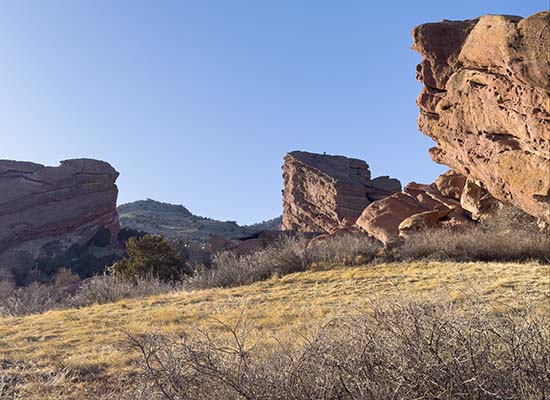
The great red monoliths dominate the landscape. They pull the eye toward cliffs, sky and impossible slabs of stone standing nearly on end.
But sometimes the most interesting way to see Red Rocks is to look down.
And then get closer.
And closer.
Looking Is Not Necessarily Seeing
There is a difference between looking and seeing.
I’m still deciding which comes first.
Do we see something and then look more closely?
Or do we look long enough that eventually we begin to see?
Photography has taught me not to be too confident about the answer.
I can spend hours outside taking photographs and still not know exactly what I’ve captured. Out there, the image is briefly a collection of light recorded on a card.
Later, on a large screen, I can enlarge it.
One hundred percent.
Two hundred.
And suddenly something that occupied a few pixels becomes a landscape.
A texture becomes a structure.
A mark becomes a question.
The photograph sends me back outside.
The Photographer’s Hike
I call this a photographer’s hike.
A photographer’s hike isn’t measured primarily in miles.
It’s measured in moments of curiosity.
Something stops you.
You don’t necessarily know why.
So, you photograph it.
Move closer.
Change the angle.
Change the light.
Look at it in color.
Look at it in black and white.
Come back another day.
Diddly.
Which was pretty much what I’d been told we would find.
I’d already spent years looking myself.
That absence is useful.
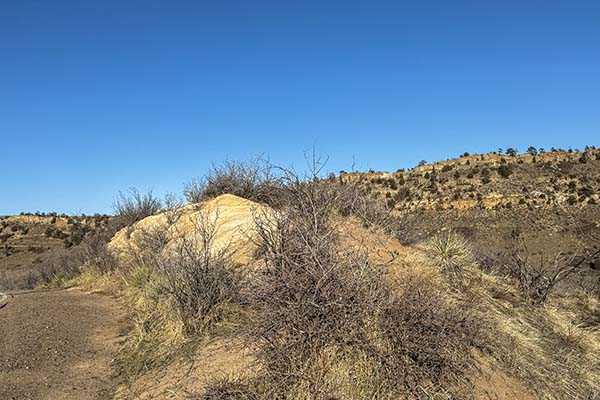
Morrison is famous for dinosaurs, but that doesn’t mean every old rock around Morrison contains a dinosaur.
A dinosaur isn’t hiding behind every sandstone ledge.
Sometimes a rock records life.
Sometimes it records the environment.
Sometimes it records movement.
And sometimes what isn’t there is part of the story.
Sometimes everybody else has disappeared halfway down the trail while you’re still staring at three square inches of rock.
That’s okay.
You’re not lost.
You’re investigating.
A Worm’s-Eye World
Change your scale and the landscape changes with it.
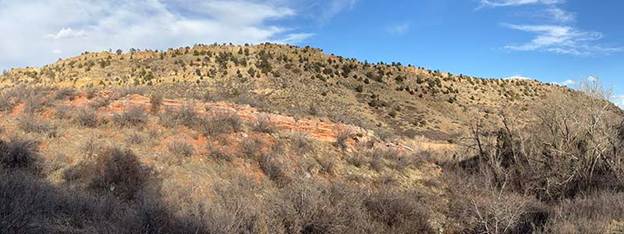
Red Rocks is cliffs, trees, valleys and sky.
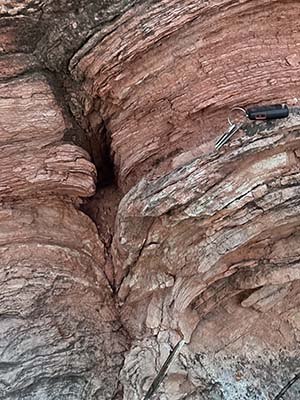
Get down close and a crack becomes a canyon.
Lichen becomes a forest.
A few grains of sand become geology.
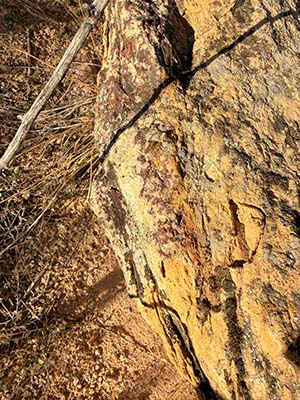
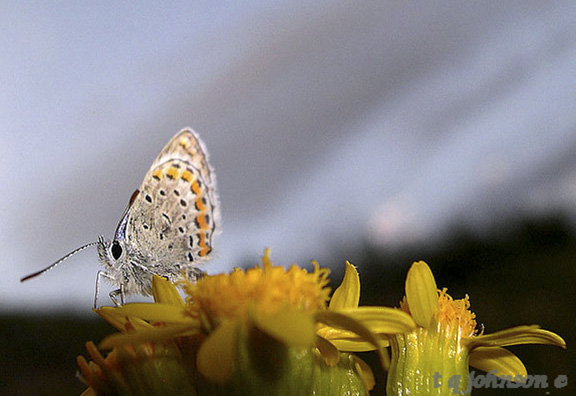
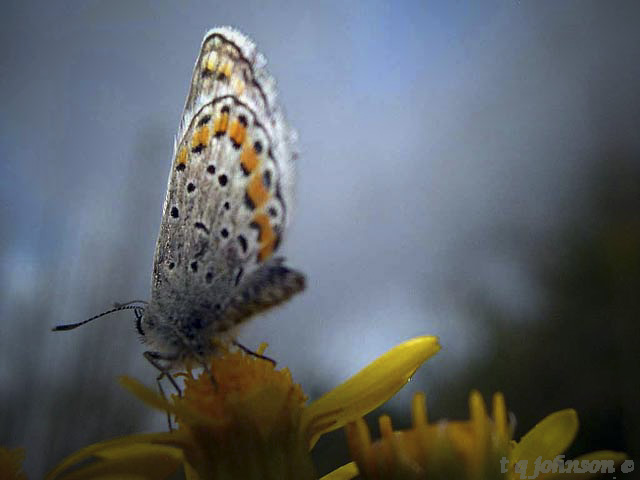
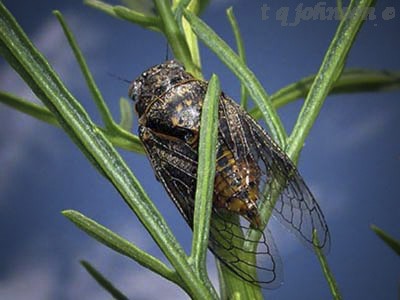
And the tiny creatures living around us begin playing out dramas every bit as complicated as those of the animals we notice more easily.
Lions and tigers and bears?
Oh my.
Sometimes they’re very small.
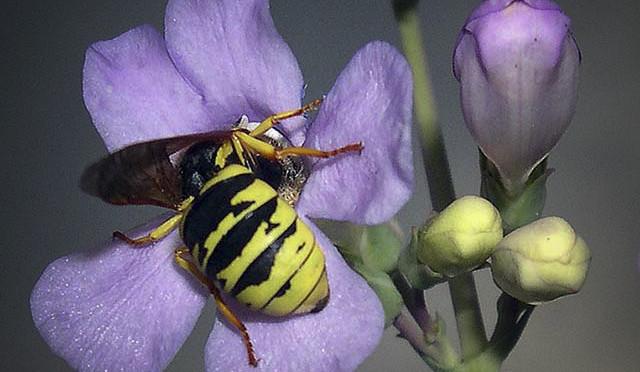
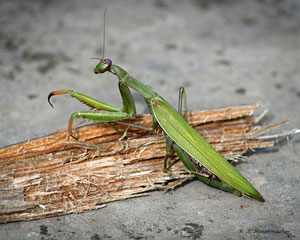
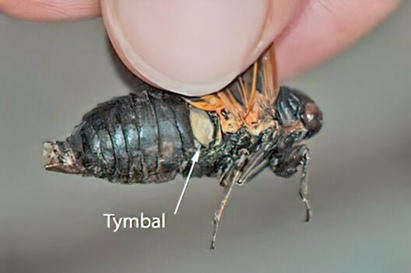
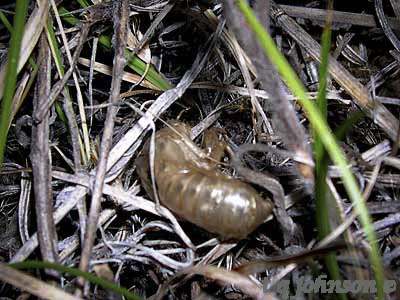
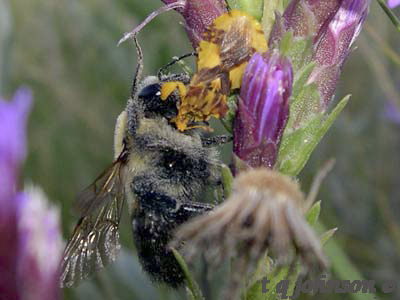
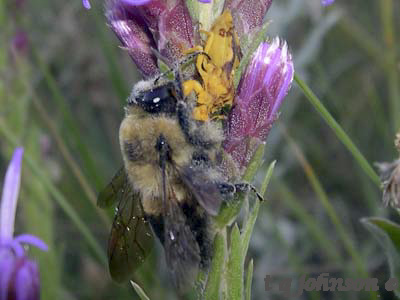
An ambush bug doesn’t need to be the size of a bear to be an impressive predator.
The stage changed.
The drama didn’t.
That is one of the things photography, art and science share:
detail matters.
Welcome to The Beach
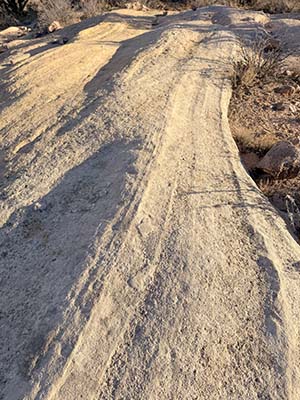
There is a pale sandstone exposure in this landscape that I call The Beach.
That’s my name for it, not an official place name.
I’m also deliberately not going to tell you exactly where it is.
The important thing isn’t finding my patch of rock.
It’s learning what to look for in the rock beneath your own feet.
The sandstone here belongs to the Permian story of the Red Rocks landscape.
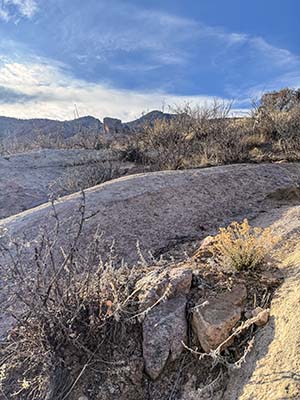
Cross-bedding preserves the movement of sediment through an environment that vanished hundreds of millions of years ago.
Think about that for a moment.
The wind is gone.
The moving sand is gone.
That landscape is gone.
But the movement remains.
Frozen in stone.
Reading Movement
Elsewhere, the texture changes again.
Rounded grains and pebbles appear.
Colors shift.
Iron contributes reds, pinks and rusty tones.
Different sediments preserve different conditions.
A rounded pebble has a history.
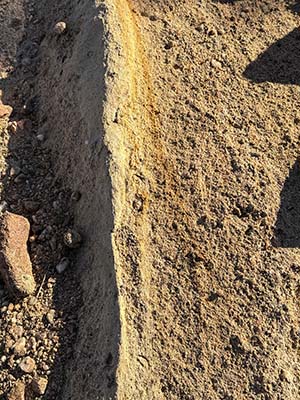
Something transported it.
Something knocked away its sharp edges.
Something moved that sand.
The rock isn’t simply an object.
It’s evidence.
This is where a photographer’s hike starts becoming something else.
You’re no longer merely photographing rocks.
You’re reading them.
Finding Diddly
Years ago, this land, which had belonged to my family for generations, was sold to the City and County of Denver. I took a group from the Morrison Natural History Museum and later returned with a couple of PhD geologists from the School of Mines into this old horse and cow pasture.
We went looking at rocks for fossils.
We spread out.
We searched.
We examined the sandstone.
We tested different rocks in the field.
And what did we find?
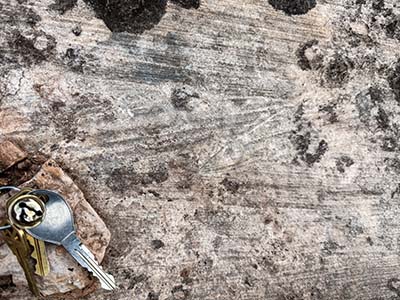
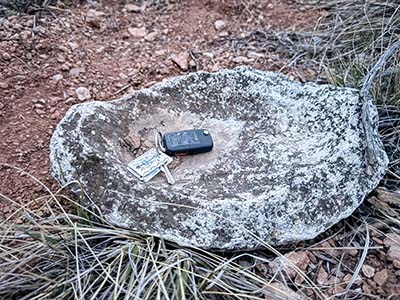
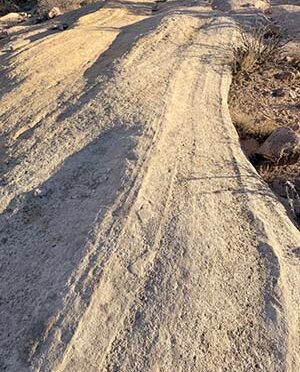
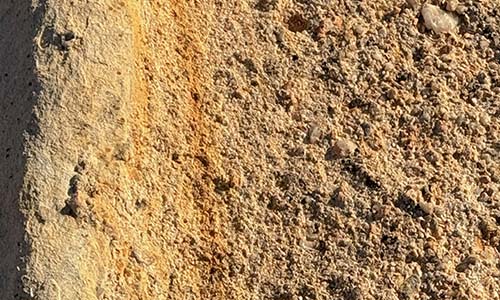
Not at The Beach. Look closely and diagonal lines appear inside the sandstone. This is from a later period, when this part of the Permian landscape was dominated by sand dunes. Above is an example of shifting dunes preserved as cross-bedding in the finer sand.
They aren’t scratches.
They’re cross-beds.
A cross-bed has a history.
So, we kept walking.
Then the Rocks Changed
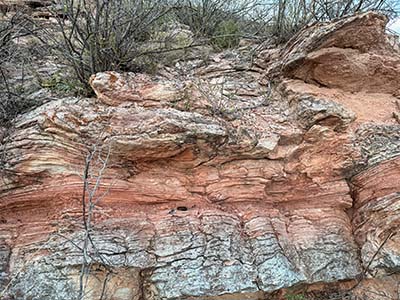
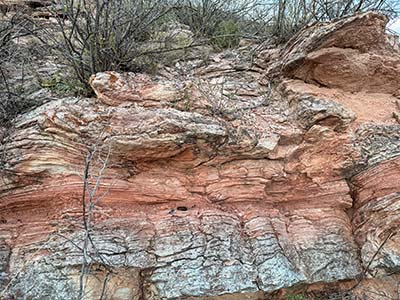
Eventually the massive sandstone gave way to something different.
Thinner beds.
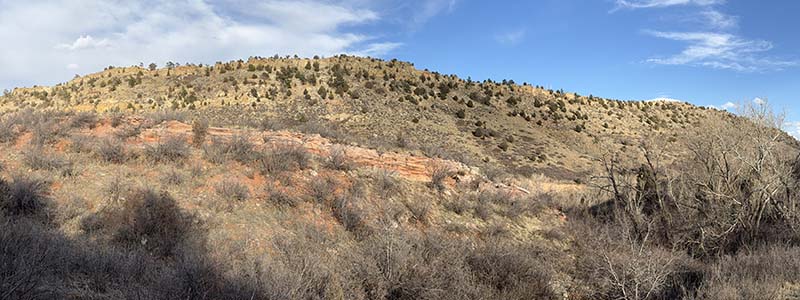
Red.
Pink.
Pale gray.
White.
Some soft.
Some resistant.
Some are remarkably finely layered.
There were clay-rich beds, carbonate rocks and evaporite-bearing layers.
The landscape had changed.
So had the questions.
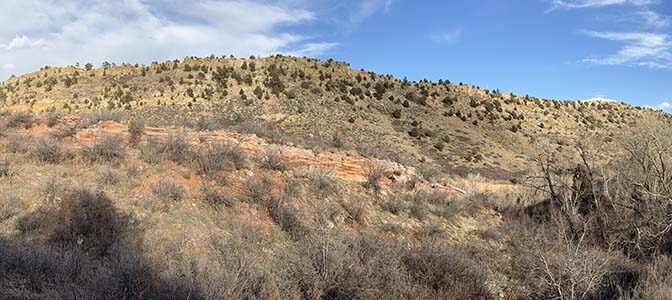
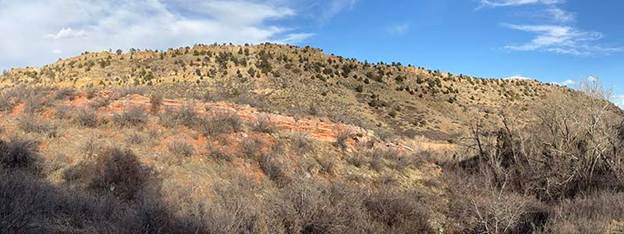
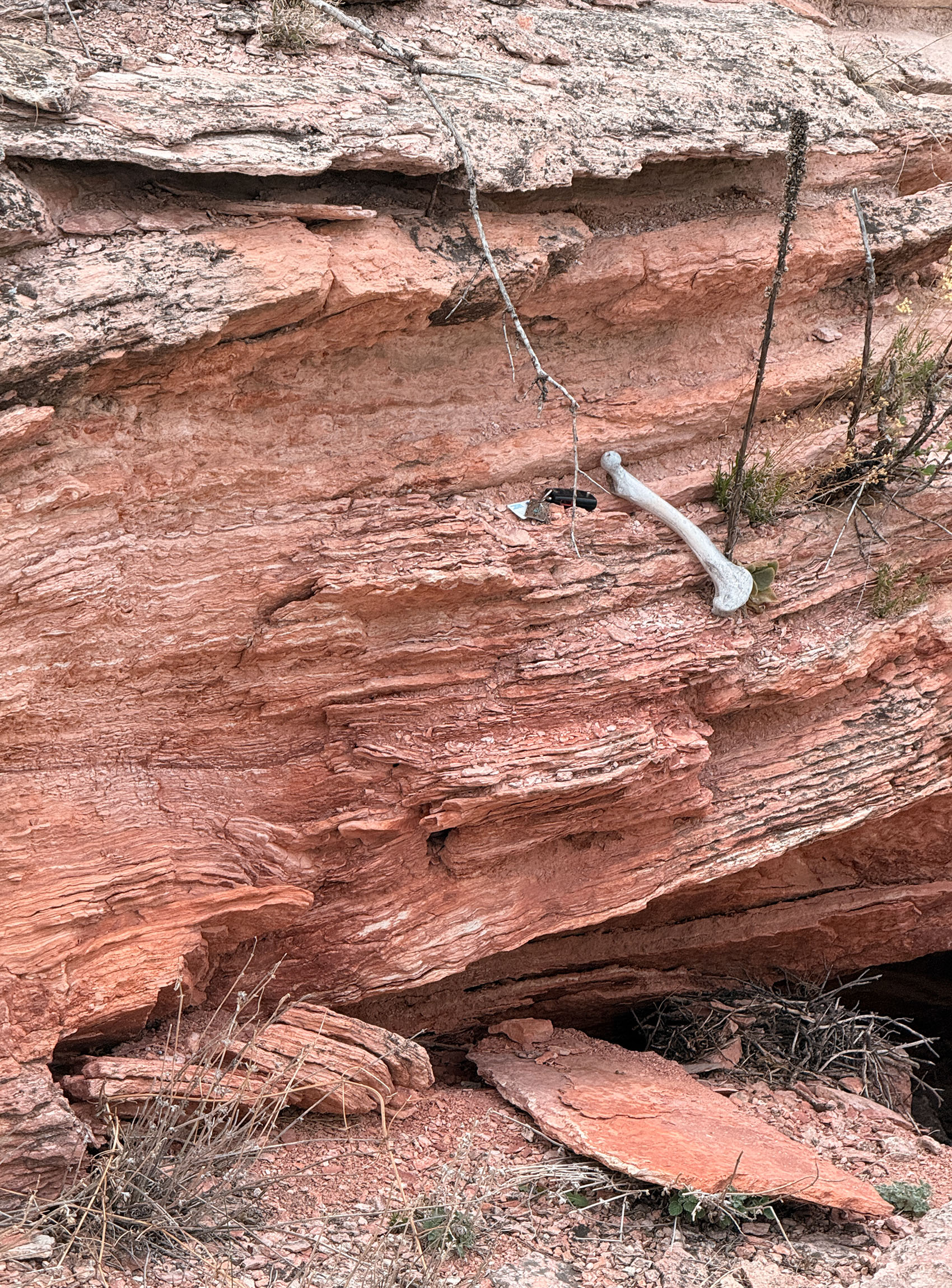
And in one little drainage I kept returning to, the rocks began doing something particularly strange.
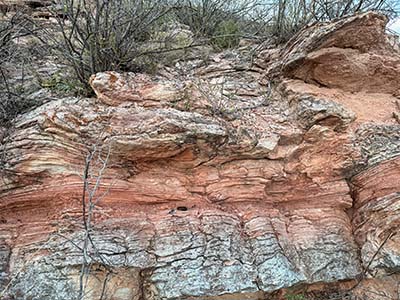
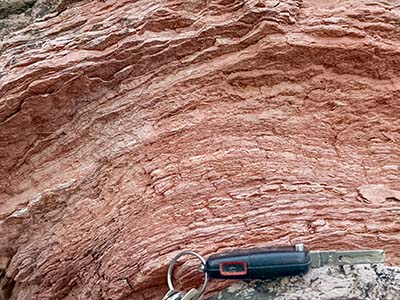
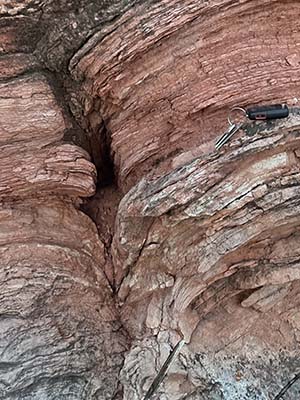
They wrinkled.
They crinkled visually into thin red and pale layers.
Rounded forms appeared above them.
Some looked like caps.
Some looked like bowls.
Some looked like absolutely nothing I’d expected to find there.
I took photographs.
Then more photographs.
Then I went home and enlarged them.
And looked again.
Because sometimes the first question isn’t:
What is it?
Sometimes the better question is:
What does it look like?
And unfortunately for respectable geology, I knew exactly what it looked like to me.
A Literal Cliffhanger
That’s where we’re stopping.
Right at the cliff.
Because Part B begins with a highly technical geological term that I have spent considerable time developing:
Bacon.
To be continued…